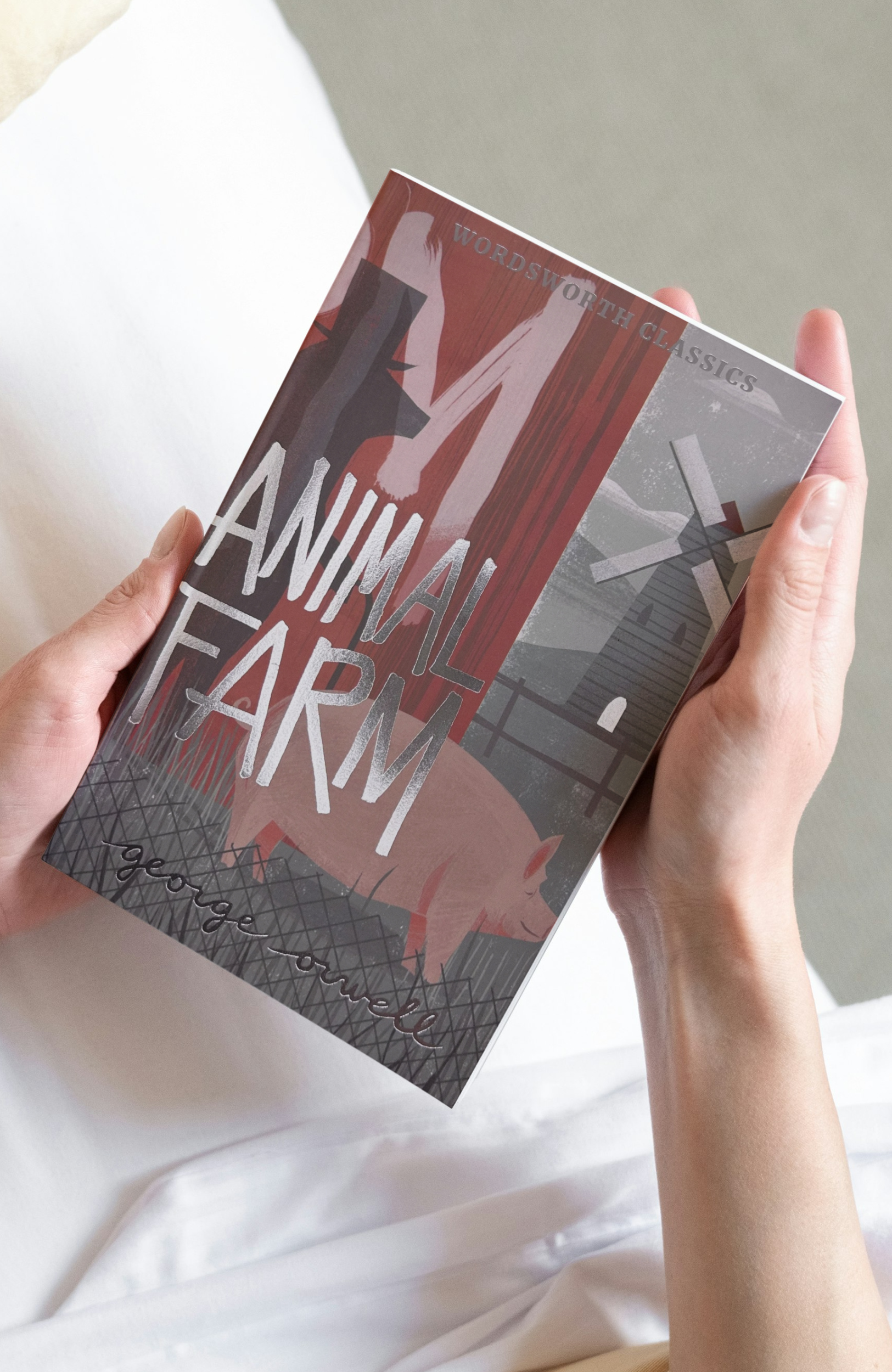
With an Introduction and Notes by Dr Andrew Palmer, Principal Lecturer in Modern Literature, Canterbury Christ Church University
ALL ANIMALS ARE EQUAL BUT SOME ANIMALS ARE MORE EQUAL THAN OTHERS
In 1943, there was an urgent need for Animal Farm. The Soviet Union had become Britain’s ally in the war against Nazi Germany, and criticism of Stalin’s brutal regime was either censored or discouraged. In any case, many intellectuals on the left still celebrated the Soviet Union, claiming that the terrors of its show trials, summary executions and secret police were either exaggerated or necessary. But, to Orwell, Stalin was always a “disgusting murderer” and he wanted to remind people of this fact in a powerful and memorable way. But how to do it? A political essay would never reach a wide enough audience; a traditional novel would take too long to write. Orwell hit on the inspired idea of combining the moralism of the traditional ‘beast fable’ with the satire of Gulliver’s Travels. A group of farmyard animals, led by the pigs, overthrow their human masters. Their revolution is inspired by high ideals: the farm will be run in the interests of its animals with no more slaughtering, plenty of food for all and comfort in retirement. But when Napoleon the pig takes command, he quickly corrupts their principles, creating a new tyranny worse than the old.
Orwell wrote Animal Farm in the middle of the Second World War, but at first no publishers wanted to touch it. It was finally published in August 1945, once the war was over. This little book quickly became a seminal text in the emerging ‘cold war’ (a phrase that Orwell himself coined). It also became a site of that conflict itself, suffering various attempts to subvert or change its meaning.
Today, Animal Farm remains a powerful fable about the nature of tyranny and corruption which applies for all ages.
Our edition also includes the following essays: Shooting an Elephant; Charles Dickens; Inside the Whale; The Frontiers of Art and Propaganda; Literature and Totalitarianism; Fascism and Democracy; Patriots and Revolutionaries; Catastrophic Gradualism; Some Thoughts on the Common Toad; Why I Write; Writers and Leviathan.
Essential cookies enable basic functions and are necessary for the proper function of the website.
Name
Description
Duration
Cookie Preferences
This cookie is used to store the user's cookie consent preferences.
30 days
These cookies are used for managing login functionality on this website.
Name
Description
Duration
wordpress_logged_in
Used to store logged-in users.
Persistent
wordpress_sec
Used to track the user across multiple sessions.
15 days
wordpress_test_cookie
Used to determine if cookies are enabled.
Session
Statistics cookies collect information anonymously. This information helps us understand how visitors use our website.
Track user interactions on your site with to optimize engagement and conversions.
Name
Description
Duration
_monsterinsights_uj
Stores anonymized user navigation history on the website, including visited URLs, page titles, and referrer information. It helps site owners analyze user journeys for improved site experience and analytics.
365 days
Marketing cookies are used to follow visitors to websites. The intention is to show ads that are relevant and engaging to the individual user.
Facebook Pixel is a web analytics service that tracks and reports website traffic.